The Last Word. · Educational Series
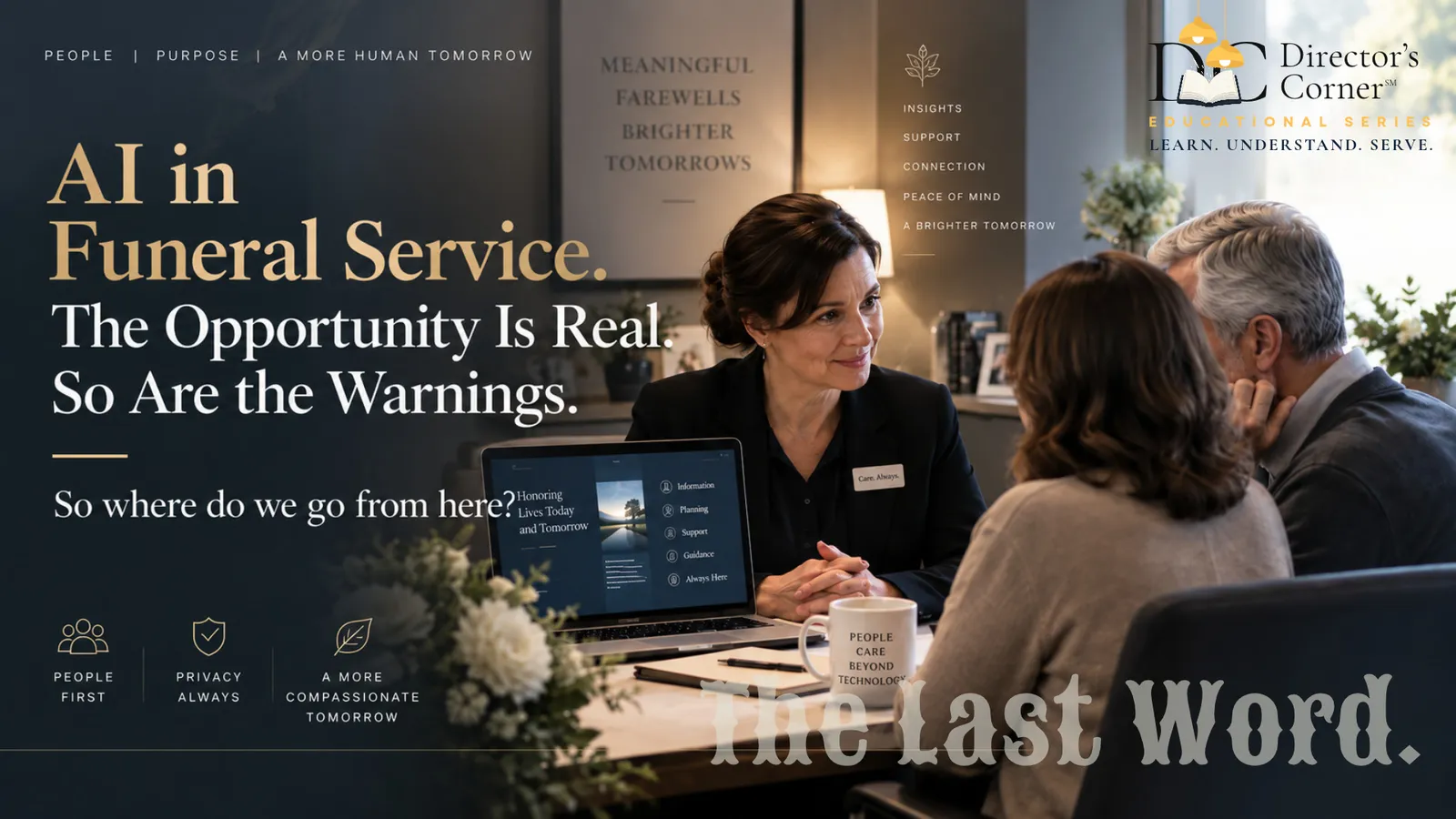
AI in Funeral Service. The Opportunity Is Real. So Are the Warnings.
Artificial intelligence is no longer something funeral service is preparing for.
It is already here.
Funeral professionals are using AI to help with obituaries, arrangement summaries, case organization, handwritten forms, communications, marketing and administrative work.
And some of the people closest to AI are also telling us to pay attention.
Dan Rather recently wrote about the emerging “Age of AI,” highlighting both the enormous potential of the technology and growing concerns around jobs, safety and whether safeguards are keeping pace with development. Anthropic CEO Dario Amodei has raised a similar concern from inside the AI industry: AI may offer extraordinary benefits, but safety and oversight need to advance with it. (Steady)
That balance is exactly where funeral service should be right now.
Not panicking.
Not resisting.
And not blindly adopting everything either.
AI Is Already Being Recognized Inside Funeral Service
One of the clearest signs of how quickly this is moving is the NFDA Innovation Award.
In 2025, Afterword’s Grace won the NFDA Innovation Award. NFDA describes Grace as an AI assistant built specifically for funeral professionals, designed to help with case files, reminders, family communications and administrative work. Passare’s AI Scanner, which uses handwriting recognition to digitize handwritten vital-information forms, placed third. (National Funeral Director’s Association)
And in 2026, Tukios’ Heardstone was named one of the NFDA Innovation Award finalists. Heardstone is designed for the arrangement process and can work with arrangement conversations, first-call sheets, handwritten notes, military discharge papers and audio clips to generate summaries, task lists, personalization ideas and draft obituaries. (National Funeral Director’s Association)
That tells us something important.
AI is not sitting outside the funeral profession waiting to get in. It is already being built specifically for funeral professionals—and the industry is recognizing it.
So the question is no longer whether funeral service will use AI.
The better question is: How should we use it?
The Opportunity
AI can save funeral professionals time.
It can reduce repetitive work, organize information, create first drafts and help staff stay on top of details.
If AI saves a funeral director thirty minutes of data entry, that should not simply mean doing more cases with fewer people.
It should mean thirty more minutes available for families.
That is where I believe AI has its greatest value.
AI should replace tasks. It should not replace relationships.
The Warnings
The benefits are real.
So are the concerns.
AI can be wrong—and sound completely confident while doing it.
In funeral service, that could mean a wrong date, an incorrect family relationship, inaccurate military information or an obituary detail that was never actually provided.
That is why AI should create the draft.
A human should still own the final result.
Privacy Needs Much More Attention
Funeral homes handle Social Security numbers, identification, military records, family information and other sensitive data every day.
Before any of that goes into an AI system, funeral-home leadership should know where the information goes, how long it is stored, who can access it and how it is protected.
Then There Is Memorialization
AI can recreate voices, images and video.
Some families may find that meaningful.
Others may find it deeply uncomfortable.
Either way, transparency matters.
There is a difference between preserving someone’s memory and creating something new in that person’s image.
What Funeral Service Needs to Decide
We don’t need to choose between embracing AI and rejecting it.
We need guardrails.
Let AI organize information.
Let people understand people.
Let AI create the first draft.
Let people make the final decision.
Let AI save time.
Then give that time back to families.
Because regardless of how advanced artificial intelligence becomes, funeral service still depends on something technology cannot replace: human trust.
The opportunity is real.
The warnings are real too.
AI is here. Now funeral service needs to decide what comes next.
What Do You Think?
Where should AI be used in funeral service—and where should we draw the line?
Angela Human is the Founder & CEO of Director’s CornerSM and the Creator of Harbor™ Deathcare OS.
Sources: Dan Rather and Team Steady, Obama, Trump and the Age of AI; Dario Amodei, We Must Pace the Frontier; National Funeral Directors Association coverage of Afterword’s Grace, Passare AI Scanner and Tukios Heardstone. (National Funeral Director’s Association)
Angela Human
CEO & Founder, Director’s CornerSM