The Last Word.
What It Takes for a Better Idea to Win
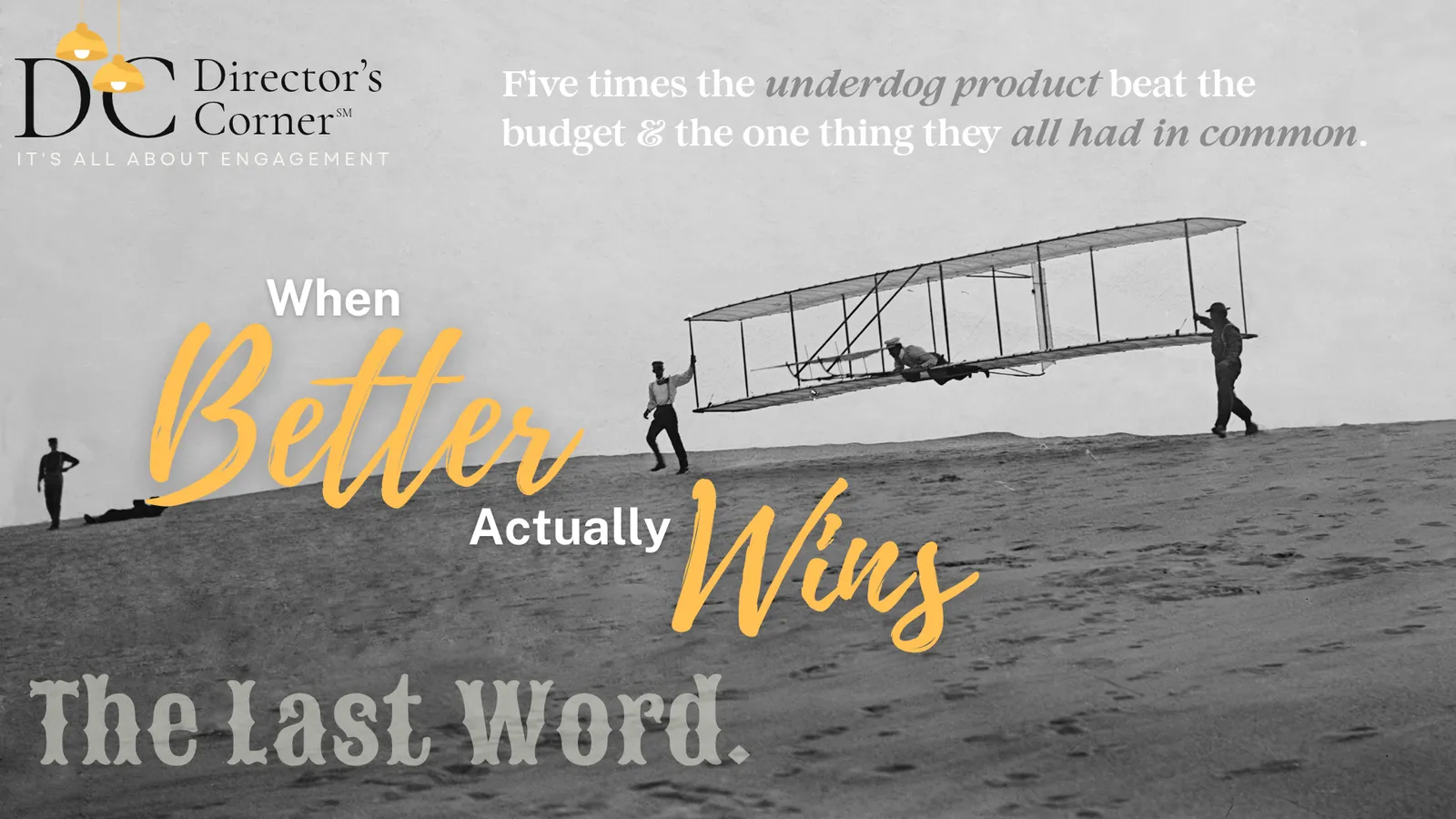
Five Times a Better Product Broke Through — and the One Condition They All Shared
Here is a question I find genuinely interesting, and I don’t think the answer is obvious.
When something better comes along, what actually decides whether it takes hold?
Not the marketing story, where the best idea sails to victory on merit alone. The real one — where good ideas sit around for years before anyone touches them, and then all at once everybody has one.
I went looking through the history for cases where the better thing did win, to see whether they had anything in common. They do.
1. Two Bicycle Mechanics Beat the Federal Government
In 1903, Samuel Langley had everything you’d want. A distinguished scientific reputation. The backing of the Smithsonian. Tens of thousands of dollars in government funding to build a flying machine.
His Aerodrome launched twice that autumn. Both times it went straight into the Potomac.
Nine days after the second attempt, Orville and Wilbur Wright flew at Kitty Hawk. They were bicycle mechanics from Dayton who had spent under a thousand dollars of their own money. When the published lift tables everyone relied on didn’t match what they were seeing in their own tests, they built a wind tunnel and worked out better numbers themselves.
They weren’t better funded. They were closer to the problem.
2. Alternating Current, and a Demonstration Nobody Could Argue With
The case for AC over DC was that it could travel the distances a country this size required. That was a physics argument, and physics arguments are hard to win on paper against an established alternative.
What settled it was Niagara Falls. By 1895 the plant was generating alternating current and sending it to Buffalo, and the debate was effectively over — not because someone made a better case, but because everyone could see the lights.
Demonstration beats argument. Reliably.
3. A Trucking Man Fixed Global Shipping
In April 1956, Malcom McLean loaded fifty-eight metal boxes onto a converted tanker in Newark and sent it to Houston.
He wasn’t a shipping man. He ran trucks, and he was tired of watching cargo get handled piece by piece on the dock while his drivers sat waiting. Ports resisted. Labor resisted. The industry’s own experts explained why it wouldn’t work.
The shipping container went on to remake world trade.
Outsiders can see what insiders have stopped noticing.
4. Toyota, and a System Built by the People Using It
After the war, Toyota built a production system designed around the people actually on the line — including the radical idea that any worker could stop production to fix a defect rather than pass it down the chain.
It was designed by practitioners rather than consultants, and it kept improving because the people using it every day were the ones changing it. We all know how that turned out.
5. And One from Our Own Profession
In 1984, the FTC Funeral Rule took effect. Itemized price lists. Prices given over the phone. No requiring families to buy packages they never asked for.
It was not universally welcomed. Plenty of thoughtful people in this profession believed it would be burdensome, or that families didn’t want to discuss money that way in the worst week of their lives.
Four decades later, the General Price List is simply how the profession works. And the funeral homes that leaned into transparency earliest are the ones that built the deepest trust in their communities. Transparency didn’t weaken the funeral home. It became the standard.
The Condition They All Share
Read those back and the pattern isn’t really about money, or timing, or luck. Better wins when people can see it for themselves.
The Wrights flew, in front of people. Niagara lit up Buffalo. A ship unloaded in hours instead of days, where the dockworkers could watch. Toyota’s line workers experienced the system every shift. Families got a price list in their hands.
In every case, the thing stopped being a claim and became an experience. And that’s when it moved.
Three smaller things follow from that:
- It helps enormously to be built by people who do the work. Practitioners notice the problems that don’t show up in a specification.
- It has to be dramatically better, not marginally. Nobody rearranges their working life for five percent. People move when the new way makes the old way look strange.
- And it takes longer than it should. Every one of these stories has years of being ignored sitting right in the middle of it.
Why I keep thinking about this
Twenty-five years in deathcare, and the thing I keep coming back to is that the only test that really matters for any tool is what it’s actually like to use at two in the morning on a first call.
That is a question a funeral director can answer for themselves in about ten minutes. It doesn’t need a slideshow, and it doesn’t need me.
Which is the whole reason Harbor is simply open. No demo, no sales call, no credit card — run a real case on it and decide. Keep whatever you’re using now and run one alongside it; that’s about twenty minutes and you’ll have an answer instead of an opinion.
— Angela
Angela Human
CEO & Founder, Director’s CornerSM